
Spasticity after stroke

What is post-stroke spasticity?
It is quite common for people to experience spasticity after a stroke. This is called post-stroke spasticity, and it happens when signals between the brain and certain muscles are disrupted. These muscles contract involuntarily and can feel tight, stiff, or hard to move, especially when stretched. Untreated spasticity can be painful and distressing, and can lead to deformity of the affected limb and difficulties performing everyday activities.1
While there are no cures for post-stroke spasticity, it can be treated with a tailored rehabilitation programme. This can help improve the often frustrating and painful symptoms over time.2
Understanding stroke
Stroke happens when the blood supply to the brain is disrupted, either by a blood clot (ischaemic stroke) or burst blood vessel (haemorrhagic stroke).3 Starved of oxygen, brain cells die, leading to a range of symptoms depending on where in the brain the stroke has occurred.4 The resulting brain damage can leave stroke survivors with lasting impacts such as speech problems and impaired mobility, as well as impacts on cognition and mental health.5
The quicker a stroke is detected and treated, the quicker blood flow can be restored to the brain – thereby reducing damage to the brain. Emergency treatment in hospital can remove or dissolve blood clots in the brain while specialist acute stroke care can improve outcomes and help prevent a second stroke.5 Early rehabilitation in hospital, such as physical therapy and speech and language therapy, can help stroke survivors recover skills and functions that may have been impacted.6 This type of support is vital in the weeks and months following a stroke.7
1 in 4
adults
over the age of 25 will have a stroke in their lifetime8
101M
people
in the world have experienced a stroke9
87%
of strokes
are ischaemic strokes10
45%
of stroke survivors
can expect to develop spasticity within 3 months11
Effects of stroke
Stroke can lead to psychological, physical, cognitive, and communication problems, including:
- Neurological deficits – tingling, numbness, a drooping mouth, or paralysis12
- Cognitive issues – difficulties with concentration, memory loss, hearing, spatial awareness, and comprehension12
- Fatigue13
- Impaired speech (aphasia)12
- Vision problems12
- Mental health challenges – anxiety and depression13
- Lack of body control – muscle weakness, tightness, or spasms12
Stroke and spasticity
Upper Motor Neuron Syndrome
When someone has a stroke, the part of the brain that controls voluntary movement can be damaged. This is known as Upper Motor Neuron Syndrome. On the one hand, this damage can be described by what is lost: motor skills, strength, or motor control, for example. On the other hand, it can be characterised by continuous and unwanted muscle activity – uncontrollable movements, spasms, or involuntary muscle contractions.14
Measuring spasticity
The impact of spasticity can be measured using the Ashworth Scale, which is used to15,16:
- Assess resistance to passive stretching
- Measure muscle tone using a five-point scale (six in the modified version)
- Assess the impact on a person’s ability to move around and their independence
- Differentiate between mild and severe spasticity
Recognising spasticity after stroke
While spasticity after stroke can go unnoticed, it´s important to recognise the signs and symptoms to be able to manage and treat the condition effectively.17
Is it spasticity?
Post-stroke spasticity can be difficult to recognise among other symptoms and may be overlooked in the early or mild stages. Spasticity looks and feels different for everyone, but there are some common symptoms to watch out for.16
Signs to look for
- Muscles that feel stiff, tight, rigid, numb, heavy, or paralysed17
Making them resistant to movement or difficult to bend or straighten through a full range of motion - Muscle weakness or paralysis17
Affecting one side of the body (known as hemiparesis) - Muscles remaining “frozen” or “locked” in certain positions17
Such as an elbow bent against the chest, a clenched fist, or pointed toes - Spasms17
Involuntary jerking or kicking movements, or uncontrolled bouncing, tremors, twitches, or shakes - Movement difficulties17
Making it difficult to walk, balance or stand up straight - A lack of body control that makes it hard to complete daily tasks17
Such as getting dressed, cooking, and cleaning
Treatment and rehabilitation exercises for post-stroke spasticity
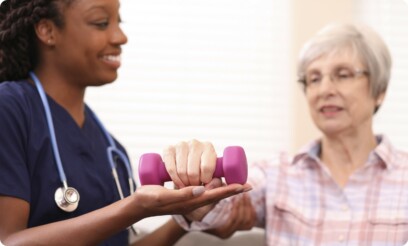
Detailed clinical and neurological assessments by stroke specialist rehabilitation teams can help to determine a personalised treatment plan. Goals can include everything from relieving pain and improving mobility to resuming everyday activities or gaining more independence.
Treatment can include physical, occupational, and speech therapies (many stroke survivors report that they continue to see improvement even after many months of therapy). Mobility aids, assistive technologies (orthoses), and medical interventions can also help to reduce spasticity symptoms. At-home exercises are also important to improve mobility and reduce acute muscle tightness.18
References
1Jacinto J, Camões-Barbosa A, Carda S, Hoad D, Wissel J. A practical guide to botulinum neurotoxin treatment of shoulder spasticity 1: Anatomy, physiology, and goal setting. Front Neurol. 2022 Oct 17;13:1004629. doi: 10.3389/fneur.2022.1004629.
2American Stroke Association. Spasticity After Stroke fact sheet. American Stroke Association. 2022. Available at: https://www.stroke.org/-/media/Stroke-Files/Support-Group-Resources/Spasticity-After-Stroke-Fact-Sheet.pdf [accessed September 2025].
3Barthels D, Das H. Current advances in ischemic stroke research and therapies. Biochim Biophys Acta Mol Basis Dis. 2020 Apr 1;1866(4):165260. doi: 10.1016/j.bbadis.2018.09.012.
4National Institute of Neurological Disorders and Stroke (NINDS). April 2020. Post-stroke rehabilitation. NIH Publication No. 20-NS-4846. National Institutes of Health. Available at: https://catalog.ninds.nih.gov/sites/default/files/publications/post-stroke-rehabilitation.pdf [accessed September 2025].
5Royal College of Physicians and Royal College of Physicians of Ireland. National Clinical Guideline for Stroke for the United Kingdom and Ireland. Chapter 3: Acute care. 2023 edition.
6Heart and Stroke Foundation of Canada. Rehabilitation and recovery following stroke. Canadian Best Stroke Practices Recommendations. 2022b. Available at: https://www.strokebestpractices.ca/recommendations/stroke-rehabilitation [accessed September 2025].
7Kernan WN, Viera AJ, Billinger SA, Bravata DM, Stark SL, Kasner SE, Kuritzky L, Towfighi A; American Heart Association Stroke Council; Council on Arteriosclerosis, Thrombosis and Vascular Biology; Council on Cardiovascular Radiology and Intervention; and Council on Peripheral Vascular Disease. Primary care of adult patients after stroke: a scientific statement from the American Heart Association/American Stroke Association. Stroke. 2021 Aug;52(9):e558-e571. doi: 10.1161/STR.0000000000000382.
8GBD 2016 Lifetime Risk of Stroke Collaborators, Feigin VL, Nguyen G, et al. Global, Regional, and Country-Specific Lifetime Risks of Stroke, 1990 and 2016. N Engl J Med. 2018;379(25):2429-2437.
9“101M people worldwide experience a stroke.” Reference: Roth G. A., Mensah G. A., Johnson C. O., Addolorato G., Ammirati E., Baddour L. M., et al. Journal of the American College of Cardiology, 2020, 76, 2982–3021.
10Virani, SS, et al. Heart Disease and Stroke Statistics-2021 Update: A Report From the American Heart Association. Circulation. 2021; 143(8), e254–e743.
11Schinwelski MJ, Sitek EJ, Wąż P, Sławek JW. Prevalence and predictors of post-stroke spasticity and its impact on daily living and quality of life. Neurol Neurochir Pol. 2019; 53(6):449-57.
12National Heart, Lung and Blood Institute. 2023. Stroke: Symptoms. Last updated 26 May 2023. National Institutes of Health. Available at: https://www.nhlbi.nih.gov/health/stroke/symptoms [accessed September 2025].
13Royal College of Physicians and Royal College of Physicians of Ireland. National Clinical Guideline for Stroke for the United Kingdom and Ireland. Chapter 4: Rehabilitation and recovery. 2023 edition.
14Thibaut A, Chatelle C, Ziegler E, Bruno MA, Laureys S, Gosseries O. Spasticity after stroke: physiology, assessment and treatment. Brain Inj. 2013;27(10):1093-105. doi: 10.3109/02699052.2013.804202.
15Escaldi S, Bianci F, Bavikatte G, Molteni F, Moraleda S, Deltombe T, Francisco G. Module 1: pathophysiology and assessment of spasticity; goal setting. J Int Soc Phys Rehabil Med. 2022 5(Suppl 1):S3-S22. doi: 10.4103/2349-7904.347807.
16Luo Z, Lo WLA, Bian R, Wong S, Li L. Advanced quantitative estimation methods for spasticity: a literature
17Glaess-Leistner, S., Ri, S. J., Audebert, H. J., & Wissel, J. (2020). Early clinical predictors of post stroke spasticity. Topics in Stroke Rehabilitation, 28(7), 508–518. https://doi.org/10.1080/10749357.2020.1843845 [Accessed September 2025].
18Royal College of Physicians. Spasticity in adults: management using botulinum toxin. National Guidelines. 2018. Available at: https://archive-rcplondon.zedcloud.co.uk/file/12449/download%202018 [accessed September 2025].